Florence, Food, Fresh made pasta, Perfect food, Reflections, Sabbatical

Exploring the Tuscan Countryside – Part 1 Update: On Fresh Ravioli and Perfect Food

I just had the ravioli (just cheeses as noted in my prior post with a bit of nutmeg in the mix) that I’d purchased from Maccheroni e raviuoli in San Casciano on Monday. For me, good food can be almost a religious experience. Prior to today, though, I have had one truly transcendent food experience.

The year we lived in Russia, we spent quite a bit of the time in late spring, early summer at our “family’s” dacha (summer house in the country). They had an amazing garden and my favorite thing was to pick and eat fresh, ripe raspberries warmed by the sun. On one particular afternoon, after swimming in the Volga River, I picked some raspberries and brought them into the house. Normally I would have shared them immediately with whoever was around. On this afternoon, our Babushka smiled at me and told me to wait. She asked me to pick more, told me she would be back shortly, then left the house with a jar and a bag.

I did as requested and filled another pot with fresh raspberries. When I returned to the house, she still wasn’t back. Grozvater (grandfather in German) gestured for me to wait. I put the raspberries on the table and went into the other room to lie down on the bed, relax, and read until Babushka came back.  I ended up falling asleep. Some time later, I awoke to Babushka’s voice whispering in the kitchen. I stretched, got up and walked into the room.

Babushka turned to the counter and picked up her small jar, now full of what I can only describe as a white, buttery looking substance. She put some berries in a bowl for me, topped them with the buttery substance, and handed me the bowl and a large spoon, a broad smile on her face. As it turns out the buttery substance was fresh, village smetana (sour cream). To call it sour cream, given what we call sour cream in the states,  especially the packaged kind we get in grocery stores (the only kind I’ve ever had) is probably a crime. It was thick, smooth, creamy and flavorful. The sourness was not too strong, making it the perfect pairing with the sweet raspberries. I put the first bite in my mouth and savored the flavors, distinct, then blending on  my tongue. It was, without doubt, the most delicious food I had ever tasted. The memory of that first bite and all those that followed stick with me almost two decades later. I don’t know if you’ve ever had this experience, but in that moment, on that particular day, I realized that I could die content. My children were with me, happy and well loved, we had enjoyed a delightful morning, and I had eaten the perfect food. Life was perfect.

Today I had another transcendent food experience. It might not stay in my memory as the smetana and raspberries have. It might not be the memory of another perfect day, but it was delicious. At the pasta shop, the pasta maker told me to keep the pasta for a day or two in the refrigerator to let the flavors mix, but to eat it within three days. He recommended serving it with melted butter, fresh chopped sage, salt and pepper, sauteed briefly in a pan. I was then to put the ravioli in the pan and coat each side with the sage butter mixture.

I have a confession to make here. I am not traditionally a fan of sage. I find it to be harsh and overbearing. It tends to dominate any food I’ve ever tasted it in, so I was not sure I’d like it. As a backup, I sauteed some garlic and tomatoes in olive oil, added chopped basil, red pepper, and a bit of salt. I thought I was good to go. I’d try the sage butter, but there was no way I was going to waste this ravioli if I didn’t like it. I was prepared. I was also 100% wrong. That second sauce is in a small bowl in my refrigerator to be used at another time.

I melted the butter in a small pan (less than 2/3rds of a teaspoon), diced up two fresh sage leaves that the proprietress of the eco-agriculture saffron farm (more on her and there in a later post) had given me for just this purpose, sprinkled with fresh ground pink Himalayan salt (it was in my cupboard), and black pepper. When the butter released the sage aroma, I knew it was ready. I carefully drained each ravioli individually as it rose to the top of the boiling water, and dropped it gently into the butter, coating both sides.
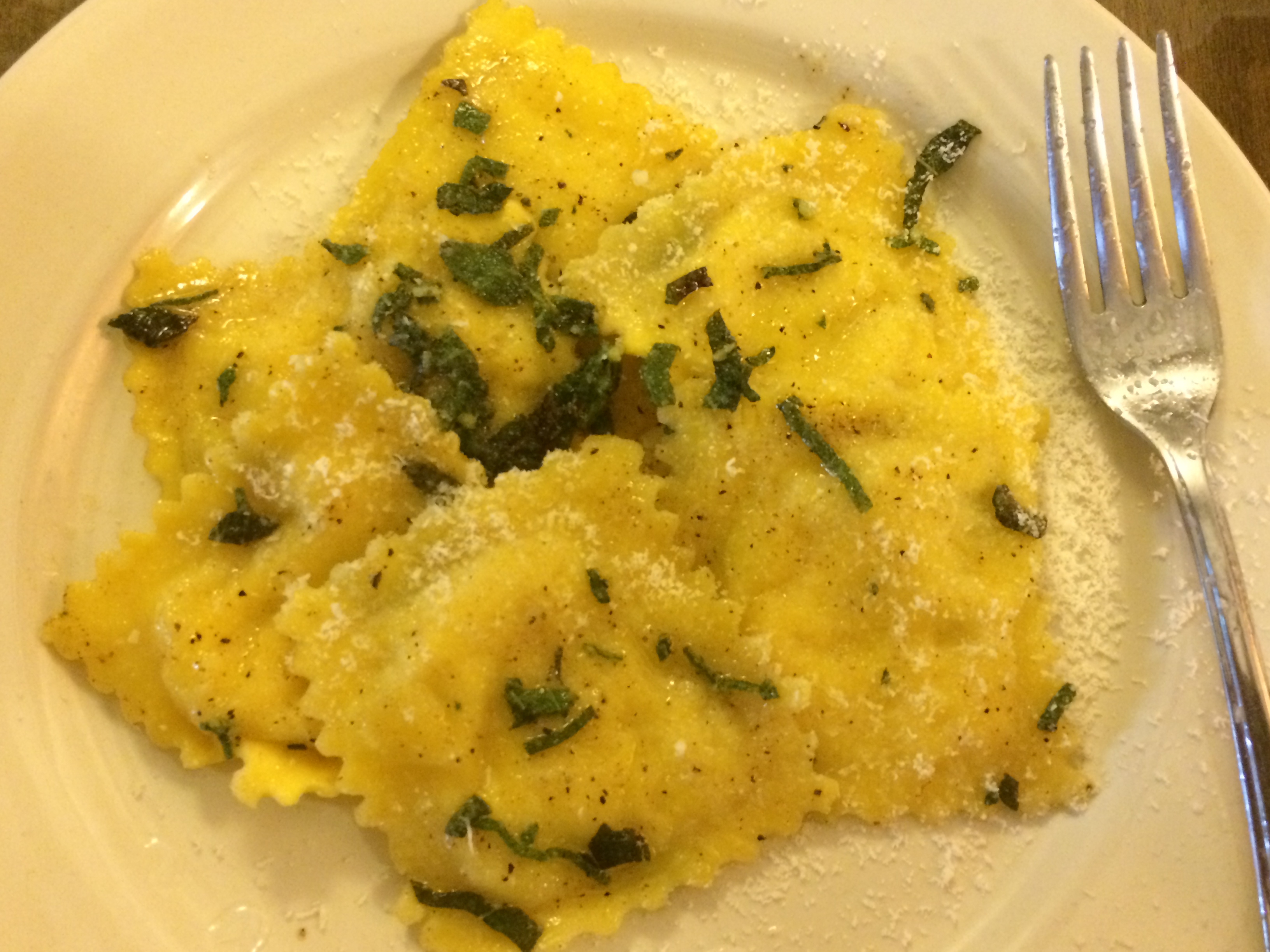
sage ravioli

The aroma of the sage was heady, but not overpowering. Tentatively, I took a bite. Mmmmmmm… The pasta was a perfectly cooked al dente (slightly chewy), the cheesy filling firm and warm. The sage butter aromatic and flavorful. The best part, all the flavors melded together to create perfection on my tongue. The sage butter was the ideal savory complement to the slight sweetness of the nutmeg enhanced cheeses, which held their own quite well in the trio of flavors delighting my palate. I am pleasingly satisfied.

While today is not (yet) as epic as that late spring day in Russia, it has promise, promise that I must now go to meet. I wish you all a great day! Caio for now!

Standard
Eataly, Florence, Food, Fresh made pasta, Italy 2014, Reflections, Sabbatical, Slow food movement, Tuscany

Exploring the Tuscan Countryside – Part 1: San Casciano – Fresh Pasta & the Slow Food Movement

817

Ok, I have a confession to make. I love food! I love shopping for it, preparing it, cooking it. Most of all, I love savoring it. I LOVE to eat good, tasty, high quality food. I have found that in Italy in abundance. Fortunately I walk all the time, so I haven’t put on any weight. In fact, I’m getting a lot stronger. I live on a hill and access is through steps or a steep street. I walk, a lot! That said, my diet is full of fresh fruit and vegetables, a bit of beef and chicken, some pasta and some bread (less of each than you might expect). I also love organic raspberry jam. I mean I LOVE it! And fresh cheeses. I have no idea what kinds they are, but I LOVE them, older, harder cheeses and younger, softer cheeses. I don’t seem to be much of a fan of goat cheese here, but cheeses made of cows’ milk are heavenly. Oh, and I love Italian wines, especially reds, although I am warming up to whites made of vernaccia grapes, delicious, but little known outside of Italy at the moment. I foresee this changing quickly. I now know the differences between Chianti, Chianti Classico, and Super Tuscans (more on those later).

So, in my quest for food and drink, I took my first excursion into the Tuscan countryside on September 15, in honor of my sister Kathy’s birthday (which was the 14th) and because I thought it was time for an adventure outside the amazing city of Florence. With Grape Tours, I took this trip into the Tuscan countryside and I met all the people whose photos you see on their site: http://www.foodtourintuscany.com.

802

Specifically we toured the chianti and vernaccia grape regions outside Florence. There were seven of us in our group guided by Kimberly, an Amsterdam native, who grew up in Chicago, IL and moved to Italy five years ago (although she spent 3 of those years in Singapore running a restaurant with her Italian husband). He now has a restaurant a bit farther South in Italy which I hope to visit. She is a sommelier. My traveling companions were a couple celebrating their 25th wedding anniversary from Minnesota who now live in New Jersey, a couple from New York on their honeymoon, and a couple from England on an adventure, as well as your intrepid narrator.

It was an amazing adventure including fresh pasta making, a tour of a winery and olive oil press, lunch at an eco-agriculture farm that grows saffron (!!!) and has a delightful bed and breakfast, a visit to historic San Gimignano where we had free time to walk the ancient streets and sample gelato from the shop that has been named “Best gelato in the world” for 8 of the last 10 years (according to our guide), and a truffle hunt with amazing truffle dogs (I’m smitten!) in the forest. (Sadly, we didn’t find any truffles.)

I think the thing that impressed me the most was the commitment to the “Slow Food” movement and eating locally, organically, and healthily that everyone we saw supported. I, personally, wasn’t familiar with the “Slow Food” movement, so I asked a lot of questions. It seems to be about eating locally, a zero carbon footprint, organic, non-pesticide, non-GMO food, and taking the time to savor what you eat. I’m in! To learn more, there are a number of relevant articles here: http://www.huffingtonpost.com/news/slow-food-movement/. A grocery store dedicated to the philosophy of healthy, local eating called Eataly was started in Italy . There are now 27 Eataly stores worldwide, 10 in Italy, including Florence, 13 in Japan, 1 in Dubai, 1 in Turkey, and 1 in Chicago and New York. Find out more here. http://www.eataly.com/global/. You can also purchase their products online through http://www.eataly.com/ which seems to fly in the face of the zero carbon footprint, eat locally philosophy they were built on, but there you go.

My next several blog posts will cover all I learned about these regions of Tuscany, wine and olive oil, organic food, saffron, and truffles. Today, I’ll talk about homemade pasta in San Casciano.

Homemade pasta in San Casciano – The first stop on our adventure was San Casciano, a hilltop village, 17.6 kilometers (10.9 miles) and a 27 minute drive (or 30 minute bus ride) from Florence. San Casciano was bombed repeatedly during WWII, so very little of the ancient architecture remains except small segments of the city wall. It is also Machiavelli’s birthplace and the site where he wrote The Prince after being exiled from Florence when the Medici family lost power in 1512.

We were here not for Machiavelli, but rather to observe a family run, from scratch, pasta shop that serves the region. Called Maccheroni e raviuoli (macaroni and ravioli), the shop is run by a mother, father, and son with one shop assistant.

793 790

They make fresh pasta throughout the day by hand and with the support of small mixing, blending, cutting and stuffing machines. They are known for their tasty desserts (Mama’s speciality) and their ravioli and homemade sauces which are popular with restaurants and families throughout the region.

After a demonstration on preparing pasta dough, slicing various types of pasta, and setting a machine to stuff fresh ravioli, I purchased some “gnudi” (literally without clothes – nude). These are the stuffing inside ravioli made of buffalo mozzarella, ricotta, and parmesan cheeses, eggs, nutmeg (the secret ingredient), and salt and pepper rolled into balls. You can add other finely cut ingredients like spinach, tomatoes, peppers, basil, sage, etc. as desired, but be careful of the moisture content. (These ingredients will likely sound familiar to anyone who makes stuffed pasta or lasagna.) To cook, you simply put the gnudi in boiling, lightly salted water until they float (just a couple minutes). After cooking them for dinner, I sprinkled mine with a bit of salt and pepper and they were delicious.

gnudi

I also purchased some of the ravioli we had watched being made. The pasta makers recommended that I hold it in the frig for a day or two before eating it as the flavor is “better, more mixed”. I’ll try that today! They recommended it with salt, pepper, butter and fresh sage. I picked up some fresh sage at the eco-agricultural saffron farm we visited later in the day (more on that in a later post). I’m to melt the butter in a pan, add chopped sage, saute for a moment, then add the pasta, mix it together and salt and pepper to taste. I’ll let you know!

As with gnudi, fresh pasta should be cooked only until it floats for a lovely al dente texture. Dried pasta takes longer because it is being rehydrated as it cooks (I’d never thought of that.). For regular pasta, fusilli, rigatoni, spaghetti, fettucine, etc., the pasta makers recommend 40% semolina flour, 60% farina (all purpose flour), and 5 eggs per kilo (2.2 pounds) of pasta dough. You will likely need to add a touch of water (less than 1/4 cup – add by tablespoons) to get it to the initial crumbly consistency you desire (30% humidity according to our host – I have no idea what 30% humidity is like, but did understand crumbly texture that binds together when you squeeze some in your hand). They don’t put salt in the pasta dough. You can add that to the water as you’re cooking. For stuffed pasta, you want a firmer dough so they recommend 50% semolina, 50% farina, and 7 eggs per kilo.  (Again, you will likely need to add a bit of water – up to ¼ cup to get the texture crumbly, but able to bind.) After cutting the pasta in desired shapes, they sprinkle the pasta with rice flour so that it doesn’t stick together.

Pasta tips: Fresh pasta is good in the frig for up to 5 days, stuffed pasta for 3. Fresh, dried pasta is best within 7 days. You can, of course, also freeze fresh pasta.

In my next post, we’ll discuss wine and olive oil. Caio!

Standard
Hunger

Yummy chicken soup and a cookbook recipe call!

Chicken soup for the soul, or how to make a quick and easy chicken soup that feeds 5 for under $15

Total cost: $13.89 with leftover food in most categories for a second batch

Necessary tools:

To me, the most indispensable item to have in your kitchen to help college students (and families) to eat well with minimal prep time is a crockpot or other slow cooker. One warning: you cannot keep a soup in the crockpot for 3 weeks and then think it will still be good. My daughter learned this the hard way and the stench that wafted through her small apartment when she took the lid off the crockpot should guarantee that she doesn’t make that mistake again. It is best to eat the first helping of whatever you make and store the rest in the frig in serving sized containers for later consumption. If you know you will eat it within a day, keeping the crockpot on warm should keep the food hot enough to stay safe. My goal when my son and daughter are home is to always have hot food available for them to graze on, so we tend to clear out a crockpot of soup or stew in one day.

Staples:

I buy chicken or beef broth whenever it is on sale. I usually have 10 cans on hand at any given time. My favorite time to buy is when the store has 10 for $10 (or less) specials.

Spices you like: For us, salt, pepper – we save the red pepper flakes and parmesan cheese packets that come with pizzas, parsley, garlic, etc. My family loves McCormick Montreal Steak Seasoning – $5.60 for 7 ounces.

Buy potatoes, carrots, celery and onions in bulk. They last pretty well and are typically cheaper that way.

Here’s my quick and easy (and delicious) chicken soup recipe:

1 rotisserie chicken – I got a ready made one from Dillons. Walmart, Sam’s, Costco, many grocery chains cook these fresh daily. The price seems to be pretty standard $4.99 to $5.99 for a smaller one (which I use – mine was $5.99), $7.99 to $8.99 for a large one. I chop my veggies in larger chunks, as I like to make a more hearty soup. Everything below can easily be upsized to feed a larger group.

3 stalks of celery (a bunch of celery should last you 3 batches of soup) – 1 bunch – $1.49

3 large carrots (a pound bag of carrots should make 2 batches of soup) I DO peel my carrots! – 2 lb bag – $2.50

2 large or 4 small potatoes (a 5 lb bag of potatoes should last your for 3 batches of soup) I DON’T peel my potatoes. I like the more rustic variation! – $3.49

¾ to 1 large white onion – $.99

2 – 32 oz packages of Swanson’s chicken broth (or 4 cans) – $3.96

Seasonings to taste: I use parsley, garlic, red pepper flakes, salt, pepper, to taste. I like the jars of chopped garlic in water – fresh garlic is also awesome). One small jar of garlic can last me for 2-3 pots of soup.

Here’s what I do:

1)      Take the chicken (I chose “savory” for this soup; you can use lemon pepper, garlic, original, or whatever variety you like), place it and any juices in the bag in the crockpot, top with ½ chopped onion, parsley, salt, pepper, garlic, and ½ of a 32 oz package of chicken broth, simmer for hours (whatever time you have available works, but I do it for at least 2 hours). I simmer the chicken in the crockpot before boning it as I want to get all the flavor I can from it into my broth.

2)      Remove chicken from broth, skin, bone and cut up meat into chunks. Set aside.

3)      Add chopped potatoes, carrots, celery and ¼ to ½ of the remaining onion to the broth. Add the rest of the broth from the package and ½ of another package to the crockpot.

4)      Return chicken to the crockpot

5)      Add seasonings to taste. I add red pepper at this point and taste the broth to see if it needs anything else.

6)      Cook until veggies are tender. This takes a couple hours.

I often do this over the course of two days, put the chicken in the crockpot and simmer all night, cut up veggies and bag them, clean the chicken in the morning, add veggies and chicken into the broth, cook on low all day while I’m at school, and we’re greeted when we get home by a mouthwatering smell and a delicious dinner. We often bake crescent rolls to eat with the soup.  $1.89 for 8.

Enjoy! If you try this, please let me know what you think.

Invitation!

So, help us out! The WSU Hunger Awareness team is trying to build a quick and easy cookbook of affordable meals for 2-5 people that college students and families can use to eat healthy. Please share you recipes here or on our facebook page: https://www.facebook.com/WSUHungerAwareness?ref=hl or on our website: wsuhunger.wordpress.com.

Image

Standard
Uncategorized

Reflections on ending the week eating on $4.50 a day

Ok, it happened! Day 6, I hit the wall! I couldn’t face any of the food I had purchased for the week. So, I changed my strategy for Days 6 and 7.  I figured out how much value remained in the food I had left and I shifted my focus to purchasing food by the day for Day 6 and Day 7. I had saved enough food to actually allow myself $4.50 a day and to keep 1 pear ($.25) and 2 eggs ($.18) from my weekly purchases, just in case.

Day 6: After midnight on Day 6, a friend invited me to IHOP. The idea of food I hadn’t been eating for 5 days was exciting! We agreed to share a meal. My friend ordered pumpkin pancakes, bacon, eggs and hash browns ($5.99 special). I ate several bites of everything and one whole pumpkin pancake. It was absolutely delicious! I didn’t eat the rest of Saturday, except for half of my pear, as I decided our shared meal counted against my $4.50. So for dinner on Saturday I had a $1.25 cheeseburger from Bionic Burger (which was so thin I could have read through it had I held it up to the light) and a handful of fries. Lettuce and tomato cost $. 30 extra each, so I didn’t get any. The burger and fries also tasted incredibly yummy!

Observation: Day 6, I had more “filler food” than nutritious food. Except my half a pear, I didn’t eat any fruits or veggies and almost no lean protein. L

Day 7: I typically have brunch with friends on Sunday mornings. When I arrived at our favorite place I told my friends that I didn’t plan to eat that day as I was going to make it on $4.50 for the whole day. One of my friends stated, “Then you can’t eat out!”… Crickets… After an awkward pause, another friend replied… “Well, that’s not fair. Anyone should be able to eat out at least occasionally”… The first friend replied, “Not on $4.50 a day, you can’t!” “That’s why I just came to hang out with you today”, I said. “I don’t intend to eat. I’m just here to visit”. Another friend said, “Well, then I’m not going to eat either. If they can’t find something you can afford, I’m not going to eat in front of you.” “Ok”, I said! “We’ll ask!” I tried to explain to our server that I was eating on $4.50 for the day and asked what 2 scrambled eggs and toast would cost. She replied, “I don’t know.” She checked with the manager who stated, “We can make you a breakfast for $4.50”. I reaffirmed, “No, $4.50 is for the whole day. I’m trying to find out if there are any low cost items I can purchase.” By this point, I had thoroughly confused the restaurant staff, so I just ordered toast and jam for $1.75. I found it interesting that my friends were much more comfortable with me eating something rather than nothing. They also understood that I would not share food with them. We ended up having a very enjoyable brunch. When I got home, I scrambled my eggs and ate the rest of my pear.

Sunday night, a friend was having a birthday party, so I went. We had pasta with homemade sauce, salad, Italian bread, and birthday cake. I ate a little of everything.

Observation: Day 7, it is really tough to eat out on $4.50 a day – unless your friends have a party!

Insights:

  • It is so much cheaper to eat low quality, minimally nutritious food on $4.50 a day. Healthy food is much more expensive. As a friend noted, “I can get a huge bag of chips for $1 or pay $3.50 for a container of fruit. On $4.50 a day, I’d go for the chips every time. A full stomach is better than an empty one”.
  •  Doing this challenge with someone else might have been easier as together we could have purchased more variety in our food. Food fatigue was one of my worst issues. I simply got tired of eating the food limited food options I’d purchased.
  • Families who use SNAP probably build staples like flour, sugar, salt, pepper, seasonings, etc. over time. We didn’t allow ourselves to count much of that in our efforts.
  • Families who use SNAP are probably better bargain food shoppers than I am and probably have longer term strategies than 1 week which allow them to build more variety in their diets.
  • It’s hard to get enough healthy calories on $4.50 a day.
  • In addition to purchasing inadequate calories, I also ended up having a problem eating the bulk of food I needed to eat each day. What I had to eat to get 1044 calories a day was simply too much food, so I averaged 750-900 calories a day. This was a very different food issue than I had anticipated.
  • Grazing, a couple bites here and there throughout the day, rather than eating meals was a great hunger abatement strategy. I carried my allotment of dried cherries and raw almonds with me and ate them, 2 or 3 at a time, throughout the day (20 of each).

Conclusion:

When I do this again (and I will), I will do it differently. I will try to make meal plans for each day rather than a week plan and work for more food variety. I will also spend more time shopping for the best deals. I did that by focusing on managers’ specials and sale items, but was unable to wait for some things to go on sale.

As I was approaching this effort, I was nervous. I had never tried to do anything like this before. I wanted to eat healthy food AND I needed the food I purchased to last the whole week. This has been an extremely insightful experience. Eating on this kind of budget is not easy. Eating healthy on this kind of budget is even more difficult.

Final thought:

I encourage anyone who wants to recognize the importance of SNAP programs and the minimal level at which they are already funded to try to eat on $4.50 a day. It makes me wonder about the links between low cost/low nutrition food, obesity, and type 2 diabetes. My hunch is that there is a link and that food insecurity likely contributes to these critical public health problems in the most vulnerable Americans.

Standard
Uncategorized

Hunger is a public health problem – Kansas Public Health Association, Virginia Lockhart Health Education Award, 9/19/13

Dr. Deborah Ballard-Reisch’s remarks upon receipt of the Virginia Lockhart Health Education Award from the Kansas Public Health Association, September 19, 2013

 I NEED TO BEGIN BY SAYING THANK YOU

1) I wish to thank Pamela O’Neal a former student, constant friend and support, and public health cliff jumper for nominating me for this award

2) I am thankful to the KPHA for honoring me with an award named after a true KS public health pioneer, Virginia Pence Lockhart

3) I am eternally grateful to the Kansas Health Foundation for endowing Wichita State University and the Elliott School of Communication with the gift that funded the Kansas Health Foundation Distinguished Chair in Strategic Communication which I have been honored to hold since August 2007. This position has allowed me to follow my passions in support of community-based approaches to research & health promotion 

4) I would like to thank my students, friends and family who both jump off cliffs with me and show me other cliffs to conquer

5) I would like to especially thank my son Stefan who is with me today and my daughter Alyssa who is a junior at UNLV for their constant love, support, and adventurous spirits. 

 WHAT IS MY PERSPECTIVE ON PUBLIC HEALTH?

 I would like to build on the perspective of Virginia Pence Lockhart – who stated in 1965 “Health cannot be given to the people, it demands their participation – beneficial action follows self education”. From my perspective, individuals and communities need to educate themselves on public health issues, while public health educators need to educate themselves on communities. Effective public health initiatives must be appropriately tailored to contexts.

 WHO AM I IN PUBLIC HEALTH?

 In the words of Rick McNary, founder of Numana Inc. of El Dorado, KS, I am in the hunger space. 

1) It gives me PAUSE that in 2012, 14.5% of US households were food insecure – 72% of them families with children. Food insecurity impacts more than 49 million Americans.

2) It gives me PAUSE that the US House of Representatives is considering a proposal to cut the SNAP program while millions of Americans are struggling to find good jobs and to afford healthy food for their families.

In public health, we talk about obesity epidemics – 1/3 of adults and 17% of children – 25.5% of the total U.S. population are obese – that’s 79 million people.

We talk about a diabetes epidemic – 8.3% of the U.S. population, 25.8 million people have type 2 diabetes.

However, it gives me PAUSE that we often overlook the potential role food insecurity may play as an underlying contributor to these problems.

 While these issues give me pause, 

1) I am INSPIRED that there are legislators who “get it”. More than 30 legislators took the SNAP Challenge to eat on $4.50 a day during August. I am grateful for the insights they gained.

Congresswoman Robin Kelly  IL stated – “You can’t get the healthiest foods because they’re too expensive”. 

Congressman Jim McGovern MA concluded – “People in this country should have a right to food, to have enough to eat, to have access to nutritious food. 

2) I am INSPIRED by Numana, Inc. and Stop Hunger Now and their food packaging efforts that allow people to “get their hands dirty” to “feed the starving” people around the globe. Empowering people leads to sustainable change.

3) I am INSPIRED by my students who even today are planning what has morphed from a WSU Hunger Awareness Day in 2010 to a month long campus-wide collaboration.

4) I am INSPIRED by our community and university partners around the world who have shared their experiences with us and invited us to speak on their campuses using our experiences as a model to help them form their own initiatives.

SO, WHAT CAN WE AS PUBLIC HEALTH PROVIDERS DO?

 1) We can educate ourselves:

Join the Wichita State University Hunger Awareness team and me. Take the SNAP Challenge and live on $4.50 a day for food! We’ll be doing this over the next two weeks. We want your blog posts, facebook posts, tweets, emails.  We understand people best when we can walk in their shoes.

2) We can take steps in our daily lives to make a difference:

Shop the Feed USA Target/ Feeding America collection sponsored by Lauren Bush at local Target stores.

Take part in the No Kid Hungry Campaign – You eat at their restaurants; they donate. Participating restaurants in the Wichita area taking part are Arby’s, Orange Leaf Frozen Yogurt, Cici’s Pizza.

Join me for the 4th Kansas Hunger Dialogue – which will be held at the Hyatt Regency in Wichita on February 26, 2014. Join university and community partners to discuss strategies to wipe out hunger here in Kansas and talk about model programs we have already developed.

Lobby Congressional representatives! Critical decisions that impact the most vulnerable Americans are under consideration now. We must make our voices heard.

In closing, I would like to quote Bob Dole & Tom Daschle in their LA Times article published September 19, 2013. “As a nation blessed with a bounty of food, we are a nation with a duty to fight hunger”.  

Food insecurity is a public health problem.  

Food insecurity is a public health problem that impacts many other public health problems.

ImageEducated, we’ve got the power to end hunger and food insecurity, perhaps not by 2015 as the UN Millennium Goals outlined, but in our lifetimes. 

Thank you again for bestowing this prestigious award on me. 

Standard
Uncategorized

Eating on $4.50 a day – Ooops! Not enough calories!

Day 2

Ooops! I didn’t consider calories as I bought my food for the week yesterday. With a focus on trying to afford healthy food, I lost track of calorie requirements. The total calories in the food I purchased yesterday was 7311. That’s an average of 1044 calories a day. A healthy weight loss diet, based on my basal metabolic rate (BMR) would be around 1458 calories per day which would lead to a 1-2 pound weight loss per week. So, the food I have for this week isn’t a decent weight loss diet for my body, and it’s absolutely not a health sustaining eating plan. To maintain a healthy weight, I’d need 1700 to 2200 calories a day. I have a feeling I might get cranky later this week.

I decided to do some research on calorie needs to maintain health. In perspective, the average 5 year old needs about 1800 calories a day to maintain healthy growth. Of course, the average will vary by child depending on growth rate and activity level. A healthy average diet for an adult is considered around 1800-2000 calories a day. While calorie needs vary depending on sex, age and activity level, women from 19-30 typically need 2,000 and 2,400 calories daily; women 31 to 50 need 1,800 and 2,200 calories per day, and women over 50 need 1,600 and 2,200 calories a day. Men 19 to 30 years old need 2,400 to 3,000 calories a day; men 31 to 50 need between 2,200 and 3,000 calories daily and men over 50 need 2,000 to 2,800 calories a day.

The calories in the food I bought aren’t enough for anyone! 

On another note, I have a sensitivity to wheat and dairy, so I didn’t include them in my shopping list. A loaf of gluten free bread and ½ gallon of lactose free milk were over $3.50 each, too large a chunk of my budget.

To recap – what I ate on day 1: Grazing worked! If I felt hungry, I ate several almonds and dried berries.

Almonds & dried berries – 150 calories
2 tbsp peanut butter – 190 calories
1 piece celery – 2 calories (probably my worst food choice was celery – no calories, minimal 1 nutrients. It’s a great vehicle to hold my peanut butter, and it offers food texture, but not much else)
20 grapes – 68 calories
1 oz chuck roast – 70 calories (I didn’t want to eat too much of the meat outside the soup, but needed some protein and it was DELICIOUS!!! I highly recommend McCormick’s montreal steak seasoning!)
1 carrot – 30 calories
2 hard-boiled eggs – 120 calories

I also had a sip of wine my friend Jessica shared with me and a sip of framboise my friend Pam shared with me and 2 free samples of macaroons ( ½ a cherry limeade macaroon, ½ a carmel sea salt macaroon at Cocoa Dolce – DELICIOUS indulgence). I have a feeling free samples will be how I treat myself this week.

Total calories: 630


I’m beginning to understand the need for high calorie, low nutrition fillers. There aren’t a lot of calories in fruits and vegetables. Chuck roast has a higher fat percentage than some meats, a plus for this eating plan, protein and fat content.

Food day 2:

My morning eating plan for day 2 included – 1/3rd of my soup allotment for the day, 1 hard-boiled egg and 1/5th of a pear, 6 almonds and 6 dried berries. My pears aren’t ripe, so I’m going to leave them out for a couple days to ripen more fully. Crispy pears aren’t bad in terms of texture, but they aren’t very tasty.

The next thing I’m going to look at is the percentage of calories I’m getting from protein, carbs and fats in what I’m eating this week.

Standard
Uncategorized

Is it a SNAP to eat on $4.50 a day?

Day 1 –

I literally started shaking at Aldi this morning as I approached the aisles of tasty food and not a lot of money in my pocket.

I have to admit that I’m beginning this exercise in eating on a budget of $4.50 a day (the average budget for a person relying on the SNAP program) with some real fear—no joke! Not since my daughter Alyssa decided we should go “raw food only” in 2010 have I been so overwhelmed thinking about food. I have never tried to eat on a specific daily budget, and trying to purchase enough food to make it through an entire week on such little money is simply terrifying.

I purchased food for the week in one trip. I wanted to be mindful to purchase healthy, nutritious food. I avoided cheap, processed food as much as possible. I didn’t have time to calculate calories to make certain that I’m getting adequate nutrition. I’ll try to do that as I go.

I decided salt, pepper and spices won’t count against my food fund. I did cheat a bit – if food I assumed was cheaper one place when it was actually cheaper in another, I repurchased and traded. This is something I obviously would not have been able to do if I was actually limited to $4.50 a day.

Thanks for my friend Sandy Kramer, I am approaching this week with a grazing strategy, so my approach to shopping was to get as much protein, fresh veggies and fresh fruit as I could buy with an eye toward portioning everything by the day.

I shopped at both Aldi and Dillons Grocery stores. I went to Aldi first; as I couldn’t get everything I wanted there, I went to Dillons. As it turned out, some food was cheaper at Dillions than Aldi. Because I had not anticipated this and because this is my first time trying to budget food in this manner, I also didn’t try to use coupons (I don’t typically collect them and didn’t have any). Were I to try to do this for the long term, I would certainly collect coupons, although I learned today that those on SNAP who use coupons have to pay taxes on them.

So, what did I purchase?

I decided the foundation of my eating this week was going to be a beef veggie soup I make that my family loves. While they’re not taking part in this journey with me, I know (hope) I can make this soup stretch as a foundation for my eating efforts this week. This soup cost $13.89

Ingredients:

1.61 lbs of chuck steak – $6.42 (I got this on sale)

2lbs frozen vegetables (corn, peas, carrots, green beans) – $2.99 (gulp! These were much more expensive than I anticipated.)

2 cans diced, spiced tomatoes (basil, oregano, onion) – $2.00

½ Vadallia onion – $.59

1 container beef broth – $1.89

Instructions:

Slow cook the meat in a crockpot (4-6 hours), top with ½ diced onion, salt and pepper and montreal steak seasoning (I couldn’t help myself. It’s just delicious!)

When the meat is done, remove from crockpot, shred, remove fat, put back in crockpot

Add canned tomatoes

Add beef broth

Cook until broth is hot. Adjust seasoning as desired.

Add 1 lb frozen veggies (We prefer carrots, peas, corn and green beans). The frozen veggies retain consistency for several days.

Cook through. Enjoy!

I’m not sure how many servings this makes. When my son Stefan is eating, he can clear the whole crockpot in a little more than a day. It takes Alyssa two days. J Mine will last 7!

Other food I purchased to flesh out the week: $17.22

1 lb grapes – $1.59

1 pomegranate – $.99

1 lb celery – $1.29

2 lbs carrots – $.99

Raw almonds – $3.70

Dried fruit – (mixed berries)  $2.49

Peanut butter – $3.49

Eggs – $1.69

4 pears – $.99

Total food bill (minus tax – SNAP participants don’t pay tax on food) – $31.11

Today so far, I ate 3 almonds and 3 dried fruit berries – 9 a.m.

3 almonds, 3 dried fruit berries – 11 a.m.

½ stalk celery, 1 tsp peanut butter and 5 grapes – 1:30 p.m.

3 almonds, 3 dried fruit berries – 3:00 p.m.

I’ve decided to carry almonds and dried fruit with me throughout the day. About to have 3 more of each.

It’s now 4:30 p.m., and I’m heading out with my friends Jessica and Pam to watch them each enjoy a glass of wine. Pretty sure I’m not going to enjoy watching, but their company will be well worth it. I’ll keep you posted on how this goes.

So, here’s an invitation! Would you like to join us on this adventure? The WSU Hunger Awareness team is taking this challenge during the next two weeks. We’re each doing 1 week solid, beginning and ending when it works best with our schedules. I chose to start today! Follow us on Facebook Hunger Awareness at Wichita State University, Twitter @WSUHunger, #WSUHunger or check out our webpage WSUHunger.wordpress.com. 

Standard
Food Insecurity, Hunger, make a difference, Reflections

Who am I on this Hunger Awareness journey?

Each of our journeys with hunger is unique. What brought us to passionately want to eradicate hunger is equally so. For me, in the autumn of 2009, I was finding my land legs in my new home at Wichita State University. I joined the faculty here in August 2007 as a professor in the Elliott School of Communication, and the Kansas Health Foundation Distinguished Chair in Strategic Communication. After more than 20 years in Nevada, I had forgotten that it takes a while to acclimate to a new place, but after 1 ½ years, I was feeling pretty settled. My daughter was doing well in school. I was learning the university. It was time to look outside our personal journeys and find something that would feed our souls, something that would allow us to make a positive difference.

The door that opened that autumn was to Numana, Inc.  and I have been committed to this organization ever since.  A colleague asked me to review some early press releases and media articles and offer suggestions. Not being a journalist, I agreed, hesitantly, but also offered to run it by my journalism colleagues. (This is one of the benefits for a social scientist of working in an integrated school of communication. If I don’t have the skills, someone else does.) I gave my feedback on content and my colleague Eric Wilson gave his on format. I was hooked. Rick McNary, founder and CEO of Numana told a compelling story of hungry children in Nicaragua and the idea of starting a “feed children in schools program”.  Children, schools, food… I was in.

My daughter, her youth group, my son, some of my graduate students,  and I took part in the first ever Numana packaging event in El Dorado, Kansas. Almost 4000 volunteers packaged more than 285,000 meals for Haiti that weekend. It was fun, exciting, and invigorating! What was unique about Numana’s effort to “empower people to save the starving” was the hands-on nature of their events. Volunteers rolled up their sleeves, donned plastic aprons, gloves and shower caps and mixed, packaged and prepared the food for shipment to Salvation Army schools in Haiti.  At tables of 12-14 volunteers, rice, soy, freeze dried vegetables, and a 21 vitamin/mineral tablet, a diet specifically designed for the metabolism of people who are starving, were measured into 6-serving bags, vacuum sealed, packed 36 to a box, and loaded on a truck, The truck would carry the food to Norfolk, Virginia, where it would be shipped by boat to Haiti. The food was expected to arrive in 6-8 weeks. Then the earthquake hit and the situation was so much more severe. Our food was airlifted in by the U.S. 82nd Airborne as some of the first food to reach Haiti following the earthquake.

Superbowl weekend, 2010, I hosted WSU Feeds Haiti, again with my daughter and a group of amazing students. Over 3000 volunteers packaged more than 641,000 meals that weekend. I continued to go to events, to offer my support, and in the first year, more than 125,000 volunteers nationwide packaged over 21 million meals at Numana events.

People want to do things that matter, that make a difference, just as I did.

Now my focus has expanded. After the Kansas Hunger Dialogue last March, I also want to understand hunger on the local level. I wanted to know if there’s a problem here on the WSU campus. I believe there is. Again, I brought together students, this time in a Health Communication Seminar, to understand the nature and scoop of hunger and food insecurity on our campus. The response has been phenomenal. Campus-wide support and interest has simply poured in.

On our website, http://wsuhunger.wordpress.com, you will be able to follow the journeys of each of the 8 students in our class. Our goal is to understand and to empower the change that is needed on our campus. This class is, for me, a way to teach what I practice, to use communication capacity, and skills, to empower others. Personally, it also keeps me on my journey to choose to do things that make a difference. I invite you to join us on this journey!

Standard
Ambassador Tony Hall, Food Insecurity, Hunger, Hunger strike, make a difference, Moveon.org

Moveon.org enters the hunger fast to impact Congressional budget decisions

Dear Friends,

When Congress can seriously debate cutting food aid to pregnant women and children while giving tax breaks to billionaires—and the only question the media asks is whether the cuts are big enough—we have a crisis.

This week progressive faith leaders called for Americans to join an ongoing fast to protest the immoral budget cuts being debated in Washington.

I’m joining the fast along with thousands of people including the leaders of many leading progressive organizations including MoveOn.org. Will you join too? You can choose to fast for part of a day, a whole day, or until the budget gets passed. Click here to join:

http://pol.moveon.org/budgetfast/?r_by=26743-17258418-gLjYkNx&rc=confemail

I think that it’s critical that we both understand what hunger is and make our voices heard. Building corporate profits through loopholes and tax breaks while taking away desperately needed services to the most vulnerable in our nation is simply unacceptable.

Thanks!

Deborah

Standard
Ambassador Tony Hall, Food Insecurity, Hunger, Hunger strike, make a difference, Numana Incorporated

I completed my 3 day, water-only fast – what’s next???? Read on!

Dear Friends,

I made it through my 3 day water-only fast with the help of my friend Mara who did it also. It was hard. At times I was light-headed, nauseous, unable to regulate my body temperature (I wore a long sleeved shirt & a hooded sweatshirt when Mara & I went for a walk in 80+ degree weather, then that night I was so hot I couldn’t sleep). I was grumpy & I had a headache most of the time. I was constantly thirsty even though I drank a lot of water every day & my eyes were painfully dry. I noted that my cognitive capacity slowed. It was difficult to concentrate & I was much slower than usual at number & comprehension games like Kakuro & memory games; I couldn’t concentrate to read for more than several paragraphs.

Of course my experience wasn’t like that of an actual food insecure person who doesn’t know where her next meal will come from (Those most affected by hunger in the U.S. are women & children.). I knew I could eat anytime I decided to. I also know that because I’d never really been hungry before, my experience was different than that of someone with chronic hunger. I thought about food constantly; I dreamed about food; my sense of smell was heightened. I smelled food everywhere.

Tonight we broke our fast at a lovely buffet at Picadilly followed by a movie. But in these 3 days I have learned so much. We’re not done though. We’re going to eat “normally” for several days, then we, along with my daughter & some other friends are going to eat on $4 a day (what food stamps provide). This will likely be more challenging than usual as food prices continue to rise. We invite you to join us.

Did you know that if the budget cuts pass 157,000 American children will lose nutrition support from Head Start programs? Not only will they lose support proven to help them perform better in school, they will also be at greater risk of hunger, obesity & malnutrition. I’ll write more about these issues later. None of this is ok with me. In fact, I think it’s immoral that anyone should suffer food insecurity & hunger in the U.S. (or anywhere in the world for that matter). Did you know that an estimated 50 million Americans go to bed hungry every day? This is unacceptable. We invite you to join us if you’d like as we continue to raise our awareness of hunger.

Three things Ambassador Tony Hall recommends on his hunger site: www:HungerFast.org

PRAY: Commit to reflection and prayer at least once per week for the Hunger Fast and for those who will be hurt by Congress’ proposed budget cuts.

FAST: Participate in the Hunger Fast by skipping a meal every day, abstaining from solid food one day per week, or forgoing solid food altogether.
LIVE ON LESS: Stand with 2.1 billion people who survive on less that $2 per day by limiting your food consumption to $2 daily. Or take the food stamp challenge at $4 per day.

This is such an important issue for our nation. I hope you will join me.

Deborah

Standard